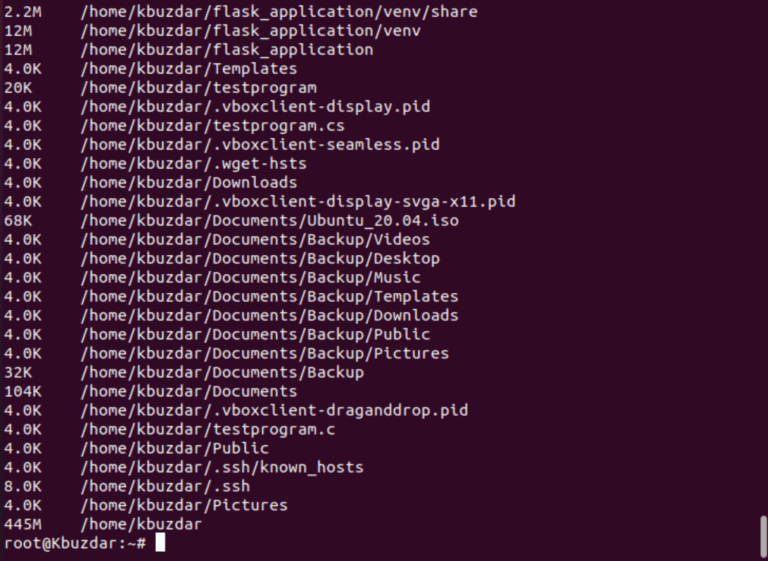
The current working directory size can be displayed with the du command adding -s and -h options. By default the du command lists all files and directories sizes recursively. But the -s option is used to show the total or summary size of the current working directory.
Du is a low-level Linux/Unix program which allows an user to get a summary of how much disk usage has been used by files and directories. Like any other standard Linux programs, the user can take advantage of many options or flags with du to modify the program output. Du can also display file sizes and directories in a recursive manner. The string given as mnt will be prepended to the file names as the mounting point (for example /usr).

By default it denotes the directory depth on recursive runs with a '+' sign. This will not follow deleted directories, because it can't. -s secondsThe time skew of the original system in seconds. For example, if the original system was 100 seconds slow, this value would be -100. -i imgtypeIdentify the type of image file, such as raw.

-o imgoffsetThe sector offset where the file system starts in the image. -b dev_sector_sizeThe size, in bytes, of the underlying device sectors. If not given, the value in the image format is used or 512-bytes is assumed. -uDisplay undeleted entries only -vVerbose output to stderr. -z zoneThe ASCII string of the time zone of the original system. These strings must be defined by your operating system and may vary.

Image The disk or partition image to read, whose format is given with '-i'. Multiple image file names can be given if the image is split into multiple segments. The du command is used to get disk usage for files and directories. The du command provides a lot of features for different cases.
By default the du command lists all files and directories sizes in a recursive manner. This creates a lot of output because of the recursive behaivour. Replace /path/to/directory/ with actual directory that you want to check. You can use "." to list all files with file size of 0 bytes in the current directory. The "-type f" argument specifies that only regular file type is returned, excluding other file types such as symbolic link, socket, directory, named pipe and etc.
Some Linux distributions may require "-print" command to print out the filenames. In this article, we've covered how to get the total size of all files in a given directory. Want to see the size of a directory from the command line?
You may have noticed that using the traditional ls command to list the contents of a a directory won't necessarily show the total size of a directory. You can use the du command (short for "disk usage") to get the size of directory from the command line in Ubuntu. It basically summarize disk usage of the set of FILEs, recursively for directories.
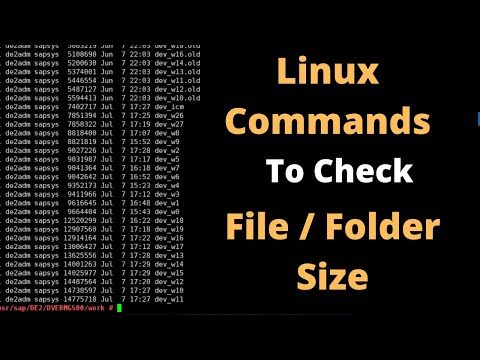
Ls and stat are command-line tools in Linux you can use to display information about files and folders, including their sizes. Du is another tool you can use to display size information, which is a dedicated tool created just for that purpose. Most Windows users know that the easiest way to check the size of a folder is to open the folder properties in File Explorer. More experienced users prefer to use third-party tools like TreeSize or WinDirStat.

In this article, we'll show you how to quickly get the size of the specific folder on the disk using PowerShell. The -s flag will insure that each specific entry is calculated, and the -h flag will make the output in human readable size format . We have discussed the disk usage commands here as well for du and the separate df command.

The code in this example lists the paths and sizes of all files and directories in the file tree rooted at the current directory. Tree is a recursive directory listing program that produces a depth-indented listing of files and output is to tty. With no arguments, tree lists the files in the current directory. When directory arguments are given, tree lists all the files and/or directories found in the given directories each in turn. Tree then returns the total number of files and/or directories listed. This will show the size of everything in the current directory, including the total size of folders and the total size of individual files, in a long list format.
Du can be used to find files or folders taking huge space in your system. You can use the info to delete offending files and folders and prevent your storage from becoming full. It is, however, not a tool to view disk usage information. In Linux, ls -l would list the files and directories in a particular path, with their names, dates, and sizes .

The reason is that ls returns meta-data for the directories, not the actual size. It is a standard Unix program that is used to estimate disk space usage in the present working directory when no path is specified. Tree is a recursive directory listing program that will list directories and files in a tree-like format.
For Debian/Ubuntu, we can install the tree by running sudo apt install tree. If you want your file size to be human-readable instead of just numbers, du has -h switch for that purpose. You just have to put -h into du command before piping it over to sort. Let's suppose we want to sort du output by size in descending order, then get only 10 files and directories that eats up the largest amount of space. In order to do that, head is another standard Linux program that comes in handy.

Directories under /scratch exist on the file server and can be accessed from every machine. Unlike users' home directories, they are not backed up, but can usually accommodate larger data files. Files that are not actively being used should be compressed if possible.

The integer returned is a bytes value because the fs module only reads file sizes in those unit types. Therefore, the returned number doesn't mean much to humans. You can do this by using both the Fs core module and some custom code to recursively go through each directory (and sub-directories) to retrieve each individual file. Once you have each file, you can easily get the sum of each of their file sizes. Usedu -hFor check all folder size of current directory recursively with there name and path.

For casual Mac users, an easier way to get the size of a directory is through the Finder using the Get Info command on any specified folder. It recursively searched for files inside the folder "/usr/" and filtered out the files with size larger than or equal to 1GB, then printed the paths of such files. It recursively searched for files inside the folder "/usr" and filtered out the files with size larger than or equal to 4GB, then printed the paths of such files. You can display the size of directories by using the du command and options. For more information about these commands, see the du man page. Alternatively, you can use the -a option with the du command to get the disk space used by each file as well as subdirectories within the specified directory.

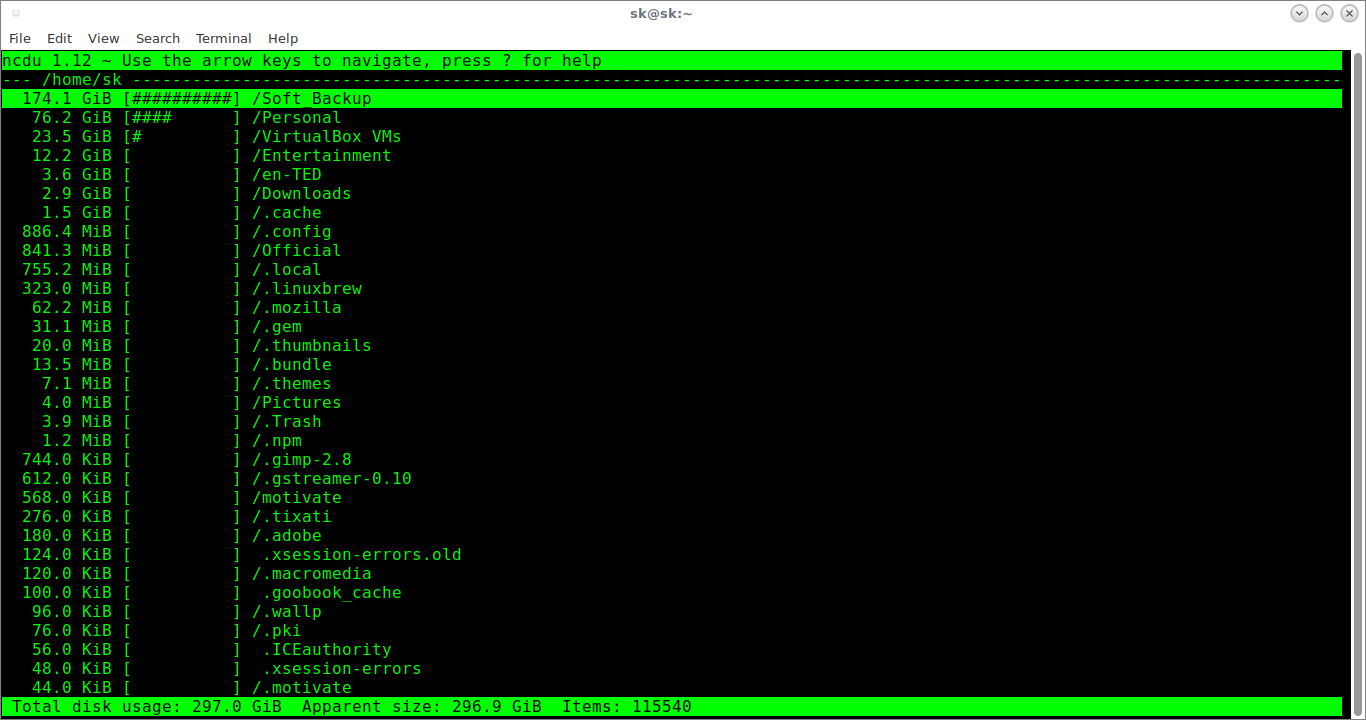
The du command either shows files and folders or just the sizes of all items which you specify on the command line (option -s). It may happen that the size of the files is different, e.g. comparing the same directory on your local hard-disk and a USB mass storage device. I use the following script, including ls to sum up the directory size. The result in in bytes taking all sub directories into account. As Nicklas points out, you may also use the ncdu disk usage analyser. Launched from within a directory it will show you what folders and files use disk space by ordering them biggest to smallest.

Files put in the /tmp directory are only accessible on the machine on which they were created and are automatically wiped everytime the computer is rebooted. Files may also be deleted with little or no warning if resources become scarce. However, if you need a large amount of disk space for a short amount of time, /tmp provides a solution which does not need any staff intervention. Remember that there is no guarantee that files stored in /tmp are safe.

Do not use /tmp for data that that is difficult or expensive to re-create. To reference your files using /tmp, use '/tmp' as the prefix to the name of the file, for example '/tmp/myfile'.. The find command in Linux provides an easy way to search files recursively in a directory hierarchy. It also provides various options to do the selective search. One such option is "-size", it helps to recursively search files by size. It recursively summarizes the disk usage to obtain a directory and its sub-directory sizes.

File Managers are GUI tools to manage files and directories. First open the file manager and right click on the directory you want to get the size. Alternatively all files and directories sizes of the current working directory can be listed by using the glob operator like below.

It is important to note here that du gives you disk usage. Different machines can use different block sizes, so on one machine a block could be 4096 bytes and another machine could contain block sizes of 2048. If I put 10 1 byte files in a machine using 4096 bytes blocks and 10 1 byte file in a machine using 2048 bytes blocks, du -h would report ~40k and ~20k respectively. It has also the advantage of being installed by default. On the other hand, the tree command would provide a more visual and detailed user interface to display almost the same results, making it a powerful alternative for du. An alternative to the already mentioned du command would be ncdu which is a nice disk usage analyzer for use in terminal.

You may need to install it first, but it is available in most of the package repositories. This will give you a list of sizes from current directory, including folders and files. I know you are able to see the byte size of a file when you do a long listing with ll or ls -l. But I want to know how much storage is in a directory including the files within that directory and the subdirectories within there, etc.

I don't want the number of files, but instead the amount of storage those files take up. The code in this example prints a sorted list of all file names in the current directory. Du is made to estimate file space usage and nothing else. To be able to sort files by time/date, we need to use ls, which lists the files in a path along with information about them. When programs crash, they sometimes report 'Core dumped' indicating that a large file called 'core' has been created in the program's current working directory. A user may disable core dumps by adding "ulimit -c 0" to ~/.bashrc.
Loop through each file in the array of file paths and generate a sum of all their individual file sizes. You can use the Get-ChildItem and Measure-Object cmdlets to get the sizes of files and folders in PowerShell. The first cmdlet allows you to get the list of files in the specified directory according to the specified criteria, and the second one performs arithmetic operations. Many times we encounter a situation where we need to find huge files in Linux. These files can be log files or some other kind of data files. If you do not specify any file or directory, du will report the disk usage of current working directory.

Use the below du command format to get the total size of each directory, including sub-directories. Another popular use case for the directory sizes is sorting directories according to their sizes. By default directories and sizes are listed according to their name alphabetically.

But we can use the sort command in order to sort directories according to their sizes. Be aware, that you can't compare directories with du on different systems/machines without getting sure, both share the same blocksize of the filesystem. This might count if you rsync some files from a linux machine to a nas and you want to compare the synced directory on your own. You might get different results with du because of different blocksizes.... If you want to get a list of 10 smallest files and directories, you can use a similar command like the one from above example. The only difference is that we now drop -r flag to sort the output in ascending order.
By default, du scans all subdirectories and includes them in the output. If you want only the direct children of the path to be scanned, put -d or --max-depth into du command like below. Each user is assigned a disk space quota, or allotment, when their account is created to insure that there will be sufficient disk space for all our users' needs. If you need additional space, please submit your request to The filecmp module defines functions to compare files and directories, with various optional time/correctness trade-offs. The key here is to use os.path.join() when we read the files.
Note that the names in the lists contain no path components. To get a full path to a file or directory in dirpath, do os.path.join. The dirnames is a list of the names of the subdirectories in dirpath (excluding '.' and '..'). The filenames is a list of the names of the non-directory files in dirpath. Otherwise, we'll return a string with the formatted bytes value to one decimal point. And the file type from the sizes array will be added to the end of the string as well.
Next, we loop over each item found by the readdirSync() function. If the item is a directory, we have the function recursively call itself to get all of the files and sub-directories inside the given directory. Get all the files in the directory by recursively going through all the sub-directories and returning an array of file paths . Better to install the coreutils; it's du comes with a lot more options, e.g. output of the actual size in bytes (which is kinda important!), inode info, apparent size etc.